
3D Slicer extension

Batch DICOM into 3D Slicer with a testable Python pipeline.

Slicer Forge is a focused 3D Slicer interface for batch DICOM work. It drives the headless DICOM Forge pipeline to de-identify series, run quality checks, convert volumes, and optionally load them into a scene.

Python 3D Slicer DICOM automation Apache-2.0

In scope now Batch ingest, configurable de-identification, QC reporting, NRRD/NIfTI conversion, and optional scene import.

See documented capabilities

Desktop validation

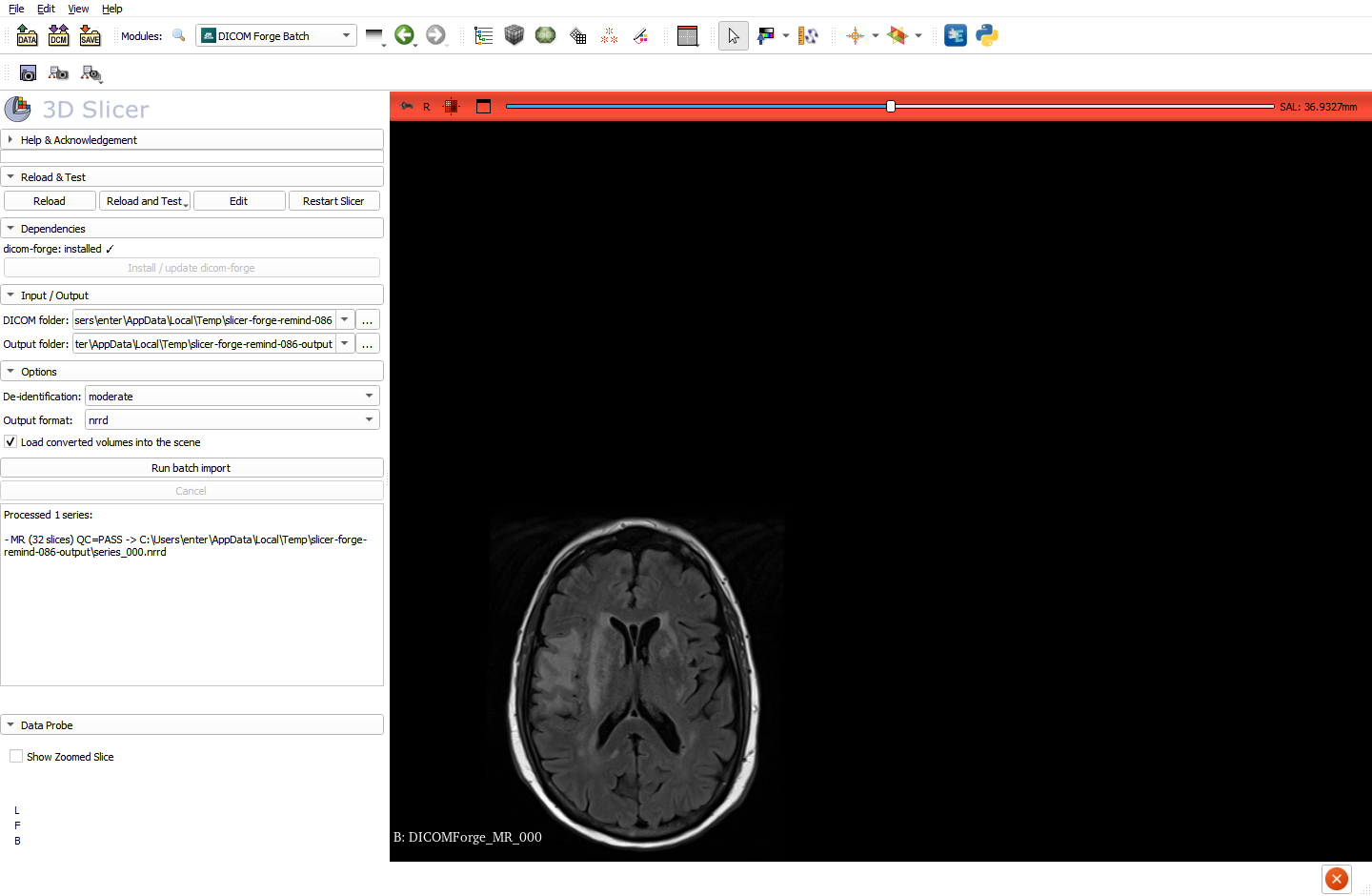
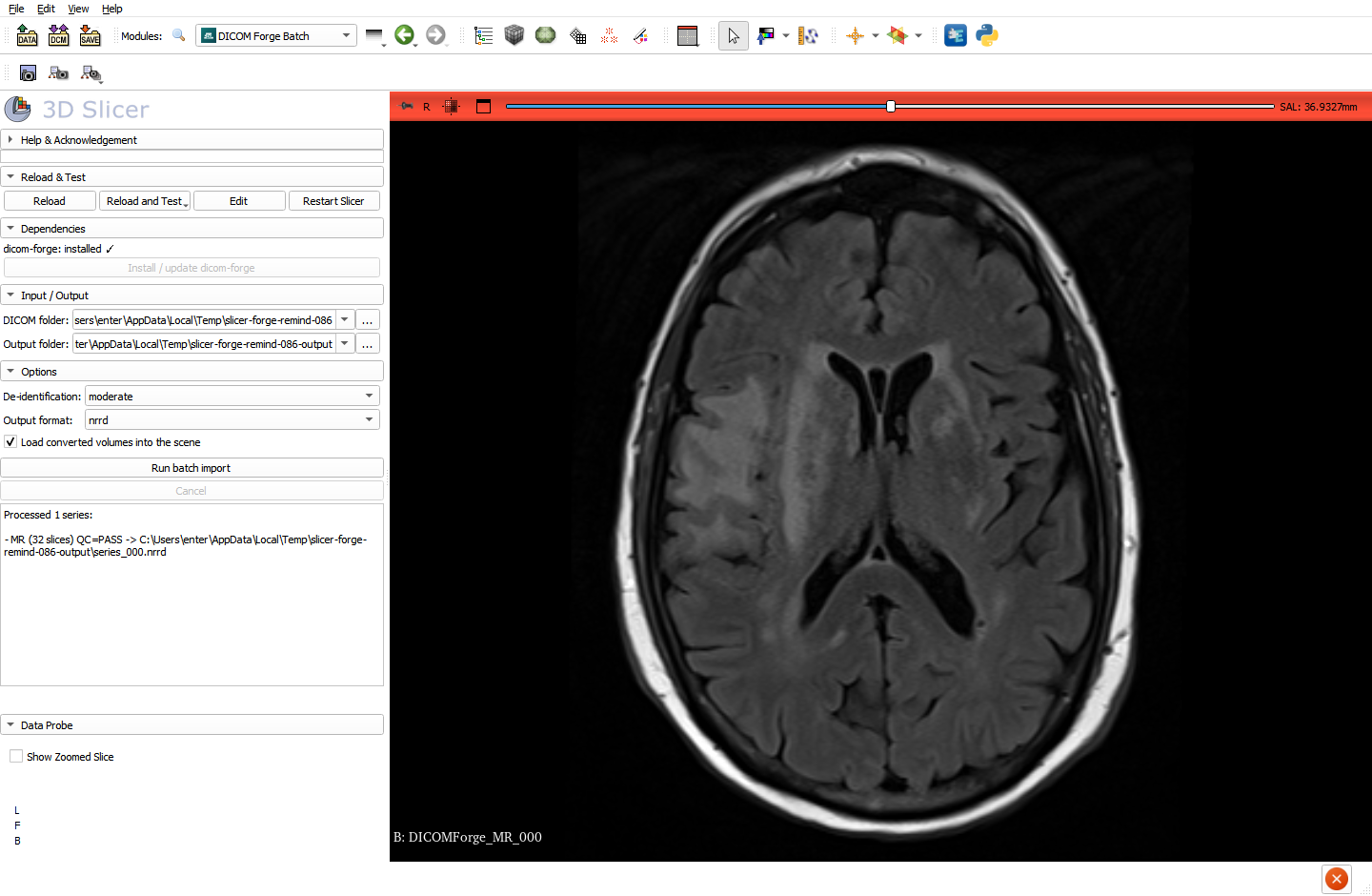
Real module. Public DICOM. Captured inside 3D Slicer.

Source and scope: public, deidentified MR data from TCIA’s ReMIND collection (CC BY 4.0), archive-assigned case ReMIND-086. These captures establish the specific 32-slice MR run shown: moderate de-identification, QC=PASS, NRRD output, and scene import. They do not establish NIfTI output, basic/strict settings, or clinical interpretation.

Implemented workflow

Five handoffs. One traceable batch path.

The extension groups files by DICOM series, processes each series through DICOM Forge, and presents a readable result inside 3D Slicer. The process below reflects the current module and its tests—not an aspirational product diagram.

  1. 01

    Ingest folders

    Select a source folder and destination. Series are discovered and grouped before the batch starts.

  2. 02

    De-identify

    Choose basic, moderate, or strict removal of patient-identifying header data.

  3. 03

    Quality control

    Capture per-series QC results, including warnings and a visible PASS or FAIL status.

  4. 04

    Convert volumes

    Write Slicer-friendly NRRD or NIfTI output, with NRRD offered as the recommended format.

  5. 05

    Import to 3D Slicer

    Optionally load every converted volume into the active scene, ready for the next workflow step.

Interactive walkthrough

Trace a synthetic batch without touching a file.

This is a browser-only illustration of the implemented pipeline sequence. It does not read, upload, de-identify, or convert DICOM data; use it to see the handoffs the Slicer module coordinates.

Pipeline trace Idle
  1. 01
    IngestDiscover 2 series
  2. 02
    De-identifyModerate policy
  3. 03
    Quality controlGeometry check
  4. 04
    ConvertNRRD output
  5. 05
    Scene import2 volumes loaded

› Awaiting a simulated batch run.

Two repositories, clear responsibilities

A thin Slicer interface backed by a headless processing engine.

SF This repository

Slicer Forge

The focused 3D Slicer extension.

DicomForgeBatch provides folder selectors, processing options, a dependency installer for Slicer’s Python environment, responsive batch controls, cancellation, and a per-series result view.

  • Scripted module in Slicer’s Informatics category
  • Qt-free logic layer reusable from the Python console
  • Standard CMake extension layout with a module self-test
Explore Slicer Forge
DF Upstream engine

DICOM Forge

The independently testable, headless pipeline.

DICOM Forge owns the processing path used by the module: ingest, de-identification, QC, and conversion. Slicer Forge installs the published package as dicom-anvil[convert], which imports as dicomforge.

  • Separates processing logic from the Slicer interface
  • Supports a scriptable and headless workflow
  • Linked as a distinct project and source of pipeline provenance
Explore DICOM Forge

Technical architecture

Keep the clinical desktop interface thin. Keep the pipeline testable.

Slicer Forge makes the handoff between a Slicer workflow and a Python processing engine explicit. The widget owns interaction; the logic owns pipeline orchestration; DICOM Forge owns the batch-processing primitives.

Inspect the module structure
Input DICOM folder one or more series
3D Slicer DicomForgeBatch Widget + Qt-free logic
Python engine DICOM Forge ingest · de-id · QC · convert
3D Slicer MRML scene optional volume import

Testing and CI

Verification reaches beyond a static code check.

The repository’s GitHub Actions workflows combine quick feedback with an end-to-end run in a real, headless 3D Slicer runtime. The tests generate synthetic DICOM data at runtime; this project does not need real patient data to exercise the workflow.

Review GitHub Actions workflows
CI surfaceCoverage in repository
01
Fast checksRuff lint, formatting check, and Python byte-compilation.
02
Synthetic dataGenerates and re-reads a small synthetic CT DICOM series.
03
Headless SlicerRuns the pipeline in a downloaded 3D Slicer runtime.
04
Workflow edgesExercises CT/MR series, both outputs, de-id levels, cancellation, and error paths.

Current implementation

What exists today

  • 3D Slicer scripted module and extension build configuration
  • DICOM folder batch processing with basic, moderate, and strict settings
  • QC summaries, NRRD/NIfTI output, and optional volume loading
  • Automated lint, synthetic-data, and headless-Slicer CI workflows

Prepared, not implemented

What remains external

The repository includes a prepared Slicer Extensions Index catalog entry, but it has not been submitted. Its documented submission checklist still calls for live screenshots and community announcement before an upstream pull request.

Read the prepared submission notes

About / project fit

Software architecture and delivery discipline around imaging workflows.

This project demonstrates a DevOps-minded software architecture: a small integration surface, a separated Python processing engine, synthetic-data checks, and automated end-to-end verification in a real headless 3D Slicer runtime.

My strengths are Python engineering, DICOM processing, automation, software integration, and test infrastructure. The focus is workflow tooling and delivery quality—not clinical image interpretation, manual segmentation, or advanced operator training.